165 years of railways to Rathdrum

Nestled at the tip of the Vale of Avoca in County Wicklow, the village of Rathdrum may not strike one as a major railway centre. However, it has an important place in the development of the railway between Dublin and Wexford, and in 2026 celebrates 165 years of a railway connection. In this article, we’ll take a look at the history of the railway in Rathdrum and the changes that have taken place over the past 165 years.
The original Rathdrum station
The Dublin, Wicklow & Wexford Railway (DWWR) reached the outskirts of Rathdrum in 1861. A station was established at Kilcommon, just over a mile north of the current station. While not convenient to the village of Rathdrum itself, it allowed the railway to serve the area pending the completion of the substantial viaduct over the Avonmore and the valley below. Initially, it would have a service of four trains each way between there and Harcourt Street, which was then the DWWR’s terminus in Dublin.
The current Rathdrum station opens
Two years later, after substantial works on the viaduct and the cutting works, the present-day Rathdrum station opened, situated more conveniently to the village. This was part of the extension through to Ovaca (now Avoca), which opened in July 1863 (with Enniscorthy being reached in November of that year). The five-arch viaduct was originally envisaged as a steel structure but was ultimately built in stone. It remains a landmark fixture in the area today.
Immediately south of the station, the line curves and descends towards the 190-yard-long Rathdrum tunnel. With the viaduct at the other end of the station, this made the station site somewhat restricted in terms of future expansion, although a sizeable goods yard was constructed. The station even boasted a turntable for a short period in the 1860s. In common with many stations on the line, the signal cabin is accessed via the footbridge. Watering facilities for steam locomotives were provided on both platforms, the main tank being located at the Avoca end of the station.
Goods traffic from Rathdrum
Apart from passenger traffic, there was significant freight traffic in the early days, too. The Mining Company of Ireland owned a lead mine at nearby Luganure, and the ore was transported to Rathdrum station by horse and cart. Here it was loaded in wagons and hauled by train to Shankill, from where it was then taken on to the smelter at Ballycorus in south County Dublin. A lot of handling was involved, but in the days before motorised road transport, it was a far more efficient alternative to carting it all the way from Luganure by horse.
General goods traffic was also important, with a goods store constructed in the yard. There was also cattle dock. The station would close to freight traffic from 30th March 1964, along with a few other stations on the route. Goods for Rathdrum was then served by a road-rail service via Wexford. This site is now in private ownership, but the building remains, with the sidings having been lifted around 1965.
Rathdrum and the railway tourism industry

A William Lawrence photo of the hotel in Rathdrum in the early days. The goods sidings behind the station are also evident
The Dublin, Wicklow & Wexford Railway was well aware of the tourism potential its route it had. In 1863, it opened a hotel at Rathdrum station, hoping to capitalise on traffic to locations such as the Vale of Avoca and Glendalough, for which Rathdrum was the closest station. This hotel closed in 1931, although the lower booking office remained in use until new station buildings were provided in the 1960s. While derelict, it has remained in largely original condition since. It imposes a striking presence over the station below.
Apart from overnight stays, Rathdrum was offered as a day trip destination. The railway company advertised tours, which involved getting a train from Dublin to Rathdrum and thence to Glendalough by jaunting car. Dublin was not the only source of tourist traffic either; special trains were operated on summer Sundays from Wexford to Rathdrum, returning in the evening.
In the Great Southern Railways era, special “Sea Breeze” trains were introduced from Dublin to Arklow, with Rathdrum being one optional destination. These excursions proved to be very popular, continuing well until at least the 1970s, by then diesel-operated under CIÉ. Indeed, so popular were they that it was not unheard of for two locomotives to be required to haul the heavy train, and sometimes additional trains had to be operated.
The footbridge collapse of 1873
Perhaps the most infamous incident associated with Rathdrum station, during the local race day on 26th April 1873 saw so many crowds use the station that the footbridge started to collapse. Fortunately, the day was saved by the quick-thinking crew of the locomotive underneath, who used a screw-jack to support the collapsing structure. A new footbridge was installed in 1876
A locomotive named Rathdrum
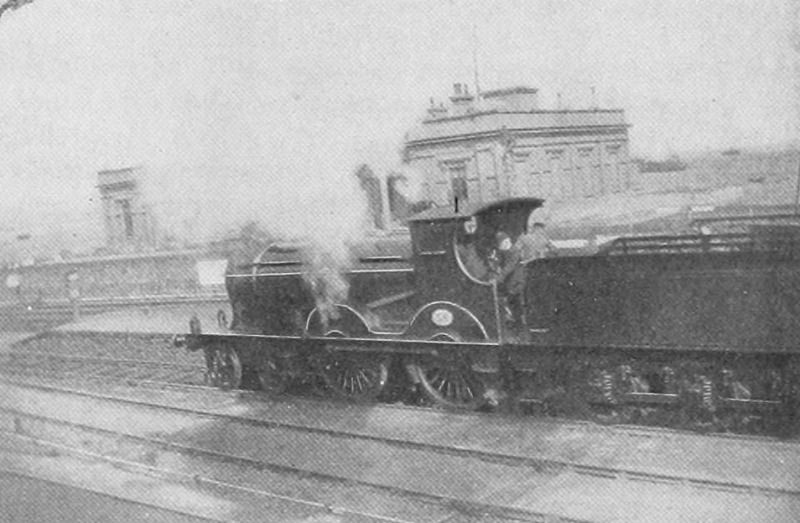
DWWR No.58 at "Rathdrum" at Kingstown (now Dun Laoghaire) in 1899, source: Britishe Bahn Wiki.
Over 1895/96, four new 4-4-0 express passenger locomotives were constructed for the DWWR by the Vulcan Foundry in England, Nos.55-58. Each of these was named after locations along its line with a ‘Rath’ prefix, with No.58 being named Rathdrum. (the others being named Rathdown, Rathmines and Rathnew). These locomotive became the D8 Class under the Great Southern Railways from 1925, being renumbered Nos.450-453, losing their names at the same time. The former Rathdrum, now GSR No.453, was the last of these engines in service, being withdrawn in 1940.
Same station, different railway companies
Like most railway stations around Ireland, Rathdrum has come under the ownership of several different railway companies over the centuries. Initially opened by the Dublin, Wicklow & Wexford Railway (which became the Dublin & South Eastern Railway in 1906), it would pass to the Great Southern Railways (GSR), following the amalgamation of 1925. Two decades later, the GSR merged with the Dublin United Tramways Company to become Córas Iompair Éireann (CIÉ) in 1945. In 1987, CIÉ created three subsidiary companies, with rail operations coming under Iarnród Éireann - Irish Rail, which brings us up to date.
The 1960s and rationalisation
As already mentioned, goods traffic from Rathdrum ceased in 1964. The sidings were disconnected and removed the following year. One siding, known as ‘The Wood Siding’ remained. This runs off the station loop and proved useful for allowing long trains to cross each other in the station. Also in 1965, the booking office facilities were moved from the former hotel building to a new, smaller building.
As a location with comparatively poor road transport connections, Rathdrum remained important for passenger traffic. It also proved a vital link in times when poor weather conditions precluded ease of access to the area; during the snow of January 1963, a special supply train was operated from Dublin to help otherwise isolated communities in the area.
For much of the following decades, Rathdrum would continue its quiet but productive existence without change. Passenger services would remain modest. By the 1990s, Rathdrum was served by three Dublin-Rosslare services each way, each day. It was also served by an additional Arklow-Dublin commuter service from Monday to Friday, departing early in the morning and returning during the evening rush. The commuter service only operated towards Dublin on a Saturday. In the 2000s, additional commuter services were introduced along the line.

A railtour at Rathdrum. Locomotives 134+142 call at Rathdrum on Ian Walsh's "Chunkrail Challenger" railtour, 8th July 2006. The special is about to partly run onto the "Wood Siding", being too long for the loop itself, to allow a Rosslare-Dublin service train to pass. Photo: N Kelly Collection.
The end of semaphore signalling
In 2008, the signalling system between Wicklow and Rosslare Europort was converted from the traditional mechanical system (involving semaphore signals and Electric Train Staff working) to the Mini-CTC colourlight system controlled from Greystones. This meant that all local signal cabins along the route closed, including Rathdrum. The final train under the old system, worked by a 2800 class diesel railcar set, operated on the morning of 14th April 2008, with the signal cabin in Rathdrum closing after its passing. The line reopened later that month, and Rathdrum would now become an unstaffed station.
Rathdrum station today

With footbridge accessibility works evident in the background, 29000 class railcar set No.29027 arrives at Rathdrum with the afternoon Dublin-Rosslare train, 26th July 2025.
Today, Rathdrum is an unusual example of an Irish country town where the rail service is far more frequent than that of the bus. The passenger train service is probably busier than ever before, with weekdays seeing six trains towards Dublin, and six southbound (a mix of Rosslare, Wexford and Gorey-bound trains). Over the course of 2025, work was carried out towards making the footbridge wheelchair accessible. The hotel, though disused, as defied threats of demolition and still stands proud over the platforms. The water tower also survives at the Arklow end of the station, and indeed was used by preserved steam train excursions into the early 2000s. Despite being unstaffed and with a much-reduced track layout, the station still offers much of interest to the historian, rail enthusiast, or general passerby. It’s a short walk from the nearby village, so why not make a day trip of it?
Love transport history? Check out our Wicklow Transport Heritage Badge collection.


Very interesting article, great history to it. I was on that Chunkrail Tour, a long day out we had been all over the place. Would be interested in a similar article about the two Wicklow stations (Murrough and existing stations)