Recap: The West Cork Wanderer—A Bus Substitution Railtour

Updated: Apr 1

Our 2026 season (and fifth year of operations) kicked off with the "West Cork Wanderer" tour on Saturday 28th March. March 2026 marked the 65th Anniversary of the closure of the West Cork Railway system. With us currently being unable to run mainline railtours due to fleet capacity constraints on Iarnród Éireann, this provided a perfect opportunity to run a 'Bus Substitution' railtour to places no longer accessible by train.
The day started with a bit of snag, as the 07:00 Dublin Heuston-Cork service was delayed departing. A considerable number of Dublin-based passengers were travelling down on this service, so we arranged to defer the bus departure until 10:30 accordingly, advising passengers so that Cork-based participants need not rush. On a plus note, the locomotive hauling this service was heritage liveried 201 class locomotive No.220, wearing the original orange it carried when delivered back in the 1990s.
With all our passengers aboard, our coach departed Kent Station just under an hour late, though this did not seem to deter spirits. Táilte Tours Coordinator Jonathan Beaumont took to the mic, introducing everyone to Ray Good of the Irish Railway Record Society's Munster Branch, who had begun his career working on the West Cork lines and was thus the best person to provide us with a history of the line. We made our way long the quays, with Ray pointing out the remains of various sidings that once served these docks.

After about 20 minutes we arrived at our first photo stop, the Chetwynd Viaduct, which still stands proud over the Bandon Road 65 years after the line's closure.

Our next stop was Bandon, were our passengers had time for a leg stretch and to take in the red brick station building, which survives today as County Council office. When then made towards the sight of Clonakilty Junction near Gaggin, where another photo stop was had. Here the line to Clonakilty diverged from the mainline, and so too did our bus tour, leaving the main road and heading on towards the coastal town.

On the way to Clonakilty, we stopped at Ballinascarthy, which itself was once a junction for a 'branch off the branch' to Timoleague and by extension Courtmacsherry. It is also famous as the home town of Henry Ford.

We ended our exploration of the old Clonakilty branch at the West Cork Model Railway Village, were we took an extended break to explore the delightful G scale replica of the former West Cork system. The carriage enthusiasts among us took the opportunity to check out carriages 1400 and 1946, two of only five surviving Park Royal carriages. These two were among the last three in service, the other being 1944, which we have previously travelled in one some of our Downpatrick trips.

Leaving Clonakilty, we wound our way through the West Cork countryside onwards to Skibbereen. Here most of our passengers opted to have lunch in the fabulous West Cork Hotel, which incorporates an original railway bridge as part of the venue.

After a fine feed and a brief walk, we reboarded our bus to head to our penultimate stop, Baltimore. The southern extremity of the old railway system, it is also the furthest south one of our tours has ever gone. Careful navigation of the town's streets by our wonderful driver, Athula, our saw us arrive near the pier. Here was there was time to take in the beautiful coastal views, along with the surviving station building, which is undergoing renovation by its owners. With everyone back on board, we departed and began the scenic climb back out of the town. The scenery was particularly spectacular here, and as we passed the former railway alignment along the inlet, it was tantalising to imagine this journey behind a 'Bandon' tank engine all those years ago.
We made our way back towards Cork city, with a final stop in Ballineen, where to the station building is subject of a restoration project by the BEDA Station House Campaign (check them out on Facebook to see how you can donate).
Retracing our steps through Bandon and under the Chetwynd Viaduct, it seemed like no time at all before we were back in Cork city and setting down at Kent Station. Despite the morning's delays, we had made up time thanks to our skilful driver, Athula, and our Dublin passengers had the option of travelling home on an earlier train than planned. It was pointed out that the last railtour on the West Cork, that run by the Irish Railway Record Society on St. Patrick's Day 1961, arrived back in Dublin as late as 3 am. All told, we didn't do too badly!

Left to Right: Niall Kelly, Táilte Tours Director, Ray Good, Irish Railway Record Society Munster Branch, Jonathan Beaumont, Táilte Tours Coordinator and Cathal Deasy, West Cork Railway Historian. Photo: Adrian Dawe.
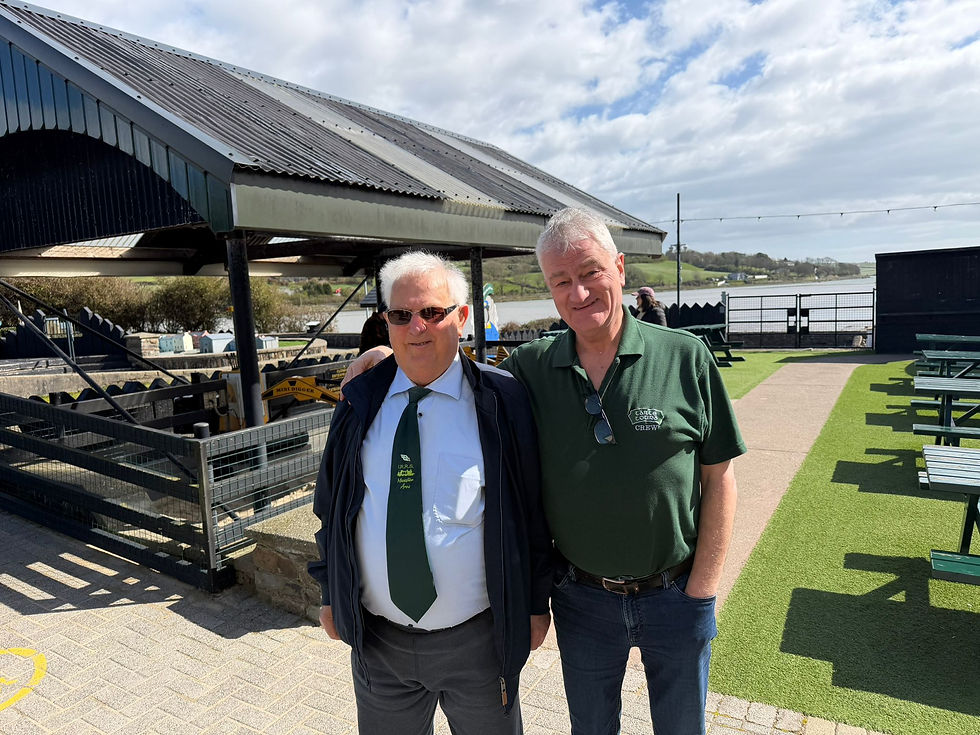
Ray Good and Jonathan Beaumont smile for the camera during our Clonakilty stop. Ray is one of the only surviving staff members to have worked on the West Cork lines.
A big thanks to everybody who supported this venture, and to Kearney's of Cork and their driver Athula for the excellent service provided throughout the day. Special thanks to West Cork Model Railway Village for having us and The West Cork Hotel, Skibbereen, for the wonderful meal provided. Last, but certainly not least, we are very grateful to Ray Good of the Irish Railway Record Society for his assistance and insights on the day.
So, the question is, which closed line shall we explore next?


Comments